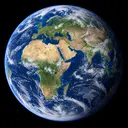
Earth
Compare Earth and the Moon, then watch the Moon travel around us. Explore their sizes, the space between them and the features on each world.
Earth on its axis
Turning here at one rotation every 12 seconds, which is 7,180 times real speed. What is not sped up: which way it turns, how far the axis leans, and how its day compares with every other planet's. Coastlines from real coordinates, the deserts and the ice where they are, and cloud banded the way it is banded — wet at the equator, stormy near 55 degrees. It turns at the real sidereal rate from the real prime meridian, so a full turn takes 23h 56m and the continents come round in the right order; which face you would see from anywhere in particular is not solved for.
?
About this model
The picture is a model. Its scale and timing depend on the selected view.
Read the note above before comparing sizes, distances or positions. The model explains motion; it is not a spacecraft flight plan.
Mon, October 12, 2026
——
Distances use AU: Earth’s average distance from the Sun, 149,597,870 km. Angles mark positions around an orbit.
Earth by the numbers
The mass is worked out from Earth’s gravitational parameter and the gravity from that and its radius; the year comes from Kepler’s third law and the width is the same figure the simulator draws with. None of them is typed in beside the picture, so none of them can disagree with it.
The moons of Earth
Earth has 1 confirmed moons. Every distance and period here is real, and they are not independent: each pair has to satisfy Kepler’s third law against Earth’s mass, which is how this table is checked rather than trusted.
| Moon | Distance | Orbit | Width | |
|---|---|---|---|---|
| Moon | 384,400 km | 27.3 d | 3,475 km | A quarter of Earth’s width, and drifting away 3.8 cm a year |
↺ marks a moon going round backwards. This system is the picture at the top of this page — press Play and watch these periods run.
Earth: things worth knowing
- The Moon is a quarter of Earth's width. Relative to its planet, it is the largest moon in the solar system by a wide margin, and this simulator's Earth & Moon view is the only one on the site drawn to scale in size and distance at once.
- It is drifting away at 3.8 cm a year, and slowing our rotation as it goes: the day lengthens by roughly 1.8 milliseconds per century.
- Earth is the only planet with plate tectonics — a crust broken into pieces that move, subduct and recycle. It is also the only planet with a long-term carbon cycle, and those two facts are related.
- The magnetic field is generated by convection in a liquid iron outer core. Mars had one and lost it; the difference in what happened to the two atmospheres afterwards is stark.
- About 71% of the surface is water, but all of it together is only about 0.02% of the planet's mass. Earth is a rock with a film of water on it.
What we still don’t know about Earth
Every one of these is genuinely unsettled — not simplified for the page, not waiting on a textbook update.
Where did the water come from?
Delivered by asteroids and comets after the Earth formed, or present in the material Earth formed from and never entirely lost? The deuterium ratio in most comets does not match Earth's oceans — 67P, measured directly by Rosetta, was three times off — while many meteorites match well. The mixture is still being argued.
When and why did plate tectonics start?
Estimates range across billions of years, from 4 billion to under 1 billion years ago, depending on which rock evidence is trusted. Nobody knows what makes a planet do it, which is exactly what you would want to know before guessing how common Earth-like worlds are.
How did the Moon form?
A Mars-sized body hit the young Earth — that much is broadly accepted. But the Moon's isotopes are nearly identical to Earth's, and most impact simulations produce a moon made largely of the impactor, which should look different. Getting a moon that looks like Earth's mantle out of a collision with something else is an unsolved modelling problem.
Recently learned about Earth
Findings reviewed August 2026. Space science moves; a date on a finding is part of the finding.
The rest of the system
Inward: Venus. Outward: Mars. Or step out: all the planets, a picture and a paragraph each, and the solar system simulator, where every orbit runs at once.
Make a link to a particular view
The date, the zoom, the span, the speed, the layers and any flight path are all in the address bar, so copying the URL shares exactly what is on screen. Set it up above, then take the link — it is the quickest way to hand a class one specific thing to look at.
The other simulator
This one is about the whole system. If the question is where the sun and the moon are from where you are standing — what time the sun comes up, why tonight's moon is the shape it is — that is the Sun, Earth & Moon movement simulator, which has a page for every city and a slider over a day, a week or a month. Between the two is the three bodies moving together — Earth going round the sun, the moon going round the Earth, on one screen and openly not to scale, keeping only the real ratio between the two periods.
And for why any of it stays up: the orbital velocity simulator takes one planet and lets you set its distance and its sideways speed by hand, so you can watch the balance that holds every orbit here — and break it, into an ellipse, an escape, or a fall into the sun.
Also: the classroom guide · sunrise & sunset by city · moon phase & moonrise · lunar eclipses · how the positions are worked out
Earth: questions without settled answers
Where did the water come from? Delivered by asteroids and comets after the Earth formed, or present in the material Earth formed from and never entirely lost? The deuterium ratio in most comets does not match Earth's oceans — 67P, measured directly by Rosetta, was three times off — while many meteorites match well. The mixture is still being argued.
When and why did plate tectonics start? Estimates range across billions of years, from 4 billion to under 1 billion years ago, depending on which rock evidence is trusted. Nobody knows what makes a planet do it, which is exactly what you would want to know before guessing how common Earth-like worlds are.
How did the Moon form? A Mars-sized body hit the young Earth — that much is broadly accepted. But the Moon's isotopes are nearly identical to Earth's, and most impact simulations produce a moon made largely of the impactor, which should look different. Getting a moon that looks like Earth's mantle out of a collision with something else is an unsolved modelling problem.